

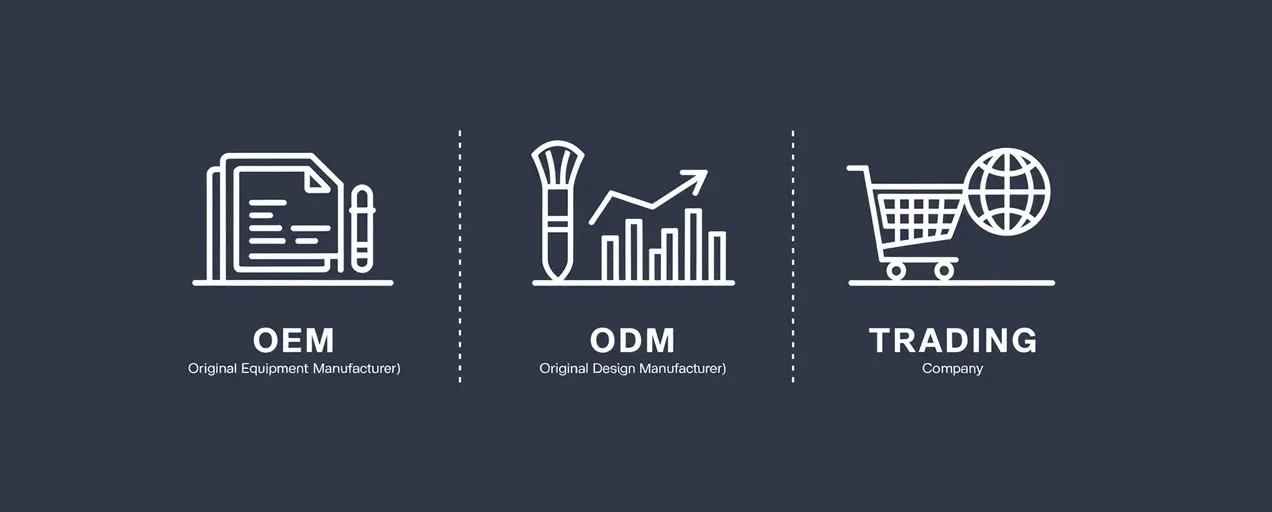
When you’re planning a new brush line, “OEM or ODM?” is usually the first big question – and then someone mentions trading companies and it gets even more confusing. This guide explains the real‑world differences between OEM, ODM and trading companies for makeup brush brands, so you can pick the model that suits your indie label instead of guessing.
What OEM, ODM and trading company actually mean?
OEM – Original Equipment Manufacturer
With OEM, you own the concept and specs, the factory builds it.
- You (or your designer) define every key detail: brush shapes, hair type and density, ferrule style, handle length and profile, finishes, logo placement and packaging direction.
- The OEM makeup brush manufacturer turns this into technical drawings, samples and mass production, following your standards.
- Designs and tools are tied to your brand; the factory should not sell your exact brush combination to others.
What this feels like for an indie brand
- Maximum control and uniqueness – great for hero brushes or a flagship set.
- More work on your side: you need clear references, feedback and patience for multiple sample rounds.
- MOQs and upfront costs (tooling, samples) are usually higher.
ODM – Original Design Manufacturer
With ODM, you start from the factory’s designs and customize them into something that feels like your brand.
- The ODM supplier shows you a catalog of existing brushes and sets that already work well in the market.
- You choose bases and tweak hair, colors, handle finishes, logos and packaging.
- The core engineering belongs to the factory, but the final look and combination can still be unique to you if you push customization far enough.
What this feels like for an indie brand
- Faster, simpler path to a professional brush line – especially for your first launch.
- Lower risk and often lower MOQs than full OEM.
- Other brands may share similar shapes if you only do light customization.
Trading company
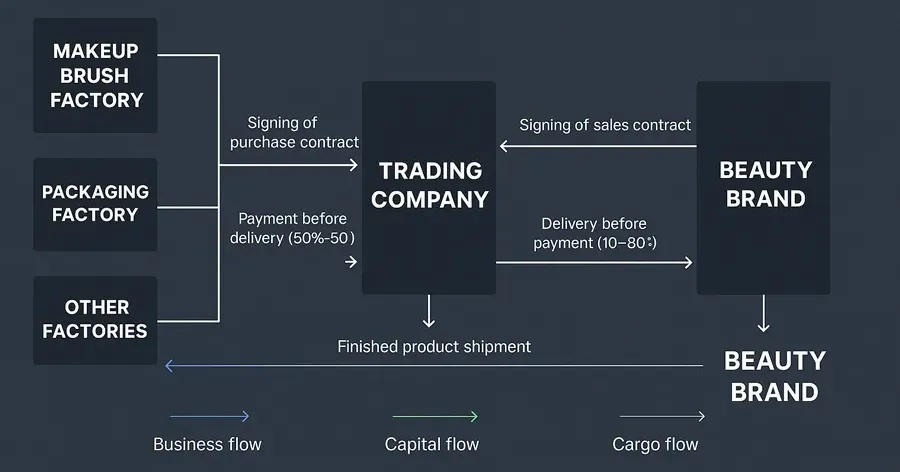
A trading company is a middle layer between you and one or more manufacturers.
- You work with a commercial company that sources brushes (and often other beauty tools) from different factories, bundles them, and manages logistics.
- Sometimes they have strong relationships with specific OEM/ODM brush factories; sometimes they shop around per project.
What this feels like for an indie brand
- Simple single point of contact, useful if you need very small test orders or mixed product categories.
- Less transparency: you may not know which factory is the true OEM/ODM makeup brush manufacturer behind your product.
- Harder to build long‑term product knowledge and consistency if they keep switching sources.
Side‑by‑side comparison for makeup brush brands
| Aspect | OEM | ODM | Trading Company |
|---|---|---|---|
| Who owns the design? | You | Mostly factory, your customisation | Factory (via trader) |
| Uniqueness level | Highest | Medium–high (depends on custom work) | Often lowest |
| Speed to market | Slowest | Medium–fast | Fast |
| Typical MOQs | Medium–high | Low–medium | Lowest but unstable |
| Upfront development cost | Highest | Medium | Low |
| Best for | Hero brushes, core line | First collection, capsule sets | Tiny tests, GWP, mixed assortments |
How to choose between OEM, ODM and a trading company
According to a report from Statista, around 70% of makeup brush brands worldwide choose OEM production because it gives them full control over product design, materials and packaging – and, as a result, stronger market competitiveness. But does that mean you should jump straight into an OEM partnership with a factory right now?
Instead of asking “which model is best in theory?”, start with your situation and work backward.
Question 1: How unique do your brushes need to be right now?
- If you need signature tools that justify a premium price and support a strong brand story, you will lean toward OEM for at least part of your line.
- If you mainly need a clean, professional‑looking set that matches your brand but doesn’t have to reinvent brush shapes, ODM is usually enough.
- If you just want something acceptable for a small test or gift, a trading company can be okay for the first run.
Question 2: How much risk can your cash flow handle?
- OEM means more sampling, possible tooling and higher MOQs – great if you have funding, POs or strong demand signals.
- ODM lets you start smaller and learn what sells before locking in fully custom shapes.
- Trading companies can sometimes offer the smallest quantities, but unit costs are higher and quality consistency may vary.
Question 3: How strong is your product and design capability?
- If you or your team understand brushes deeply (head geometry, fiber types, use‑cases), you can get full value from an OEM makeup brush manufacturer.
- If you know the look and price you want but not all technical details, an experienced ODM factory can fill the gaps.
- If you barely know where to start, a trading company might feel easier at first – but try to move closer to a direct OEM/ODM partner as soon as you have clarity.
Practical scenarios for indie makeup brush brands
Scenario A: First brush capsule, limited budget
You want a small set that feels premium, but you’re not ready to bet big on one design.
- Use ODM with a brush‑focused factory. Choose 5–7 base brushes, then invest in custom handles, finishes and packaging to make them “yours”.
- Keep MOQs modest and plan a phased rollout – for example, launch online first, then reorder for retail once you see traction.
Scenario B: Growing brand ready for a signature hero set
You already sell brushes or other tools and have a clear visual identity.
- Keep supporting SKUs on ODM for flexibility.
- Work with an OEM makeup brush manufacturer to develop 1–3 truly unique hero brushes – the ones you’ll feature in campaigns and education.
- Accept higher development cost on these SKUs; they are your long‑term differentiators.
Scenario C: Established niche brand with strong product roadmap
You have repeat customers, clear positioning and upcoming launches planned 12–18 months ahead.
- Shift most of your line into OEM with one or two key partners, possibly in different regions for risk management.
- Use ODM only when you want fast tests or seasonal extras.
- Avoid relying on trading companies long‑term; they can stay as backup suppliers for special projects.
Common misconceptions to avoid
“OEM is always better than ODM.”
Not necessarily. For many indie brands, an ODM start is smarter: you get quality and a faster launch, then evolve hero SKUs into OEM once you know what customers love.
“Trading companies are only for low‑end products.”
Some trading companies work closely with good factories, but you still lose direct control and transparency. Treat them as a bridge, not a permanent solution if you care about long‑term brush development.
“Once I pick a model, I’m stuck with it forever.”
You can evolve: start with ODM + trading to test ideas, then move best‑sellers to direct OEM or ODM relationships with your chosen makeup brush manufacturer. The important thing is to know what each model is good for and when to switch.
Putting OEM, ODM and trading in context
Understanding the differences between OEM, ODM and working with a trading company gives you the language and context you need before you ever contact a supplier. Once you know which model fits your stage, the next step is to shortlist real partners, review samples and audit factories. For a full, step‑by‑step walkthrough of finding, evaluating and choosing the best makeup brush manufacturer for your indie brand, use this article as a companion to our main guide “How to Find the Right Makeup Brush Manufacturer for Your Brand”.

