

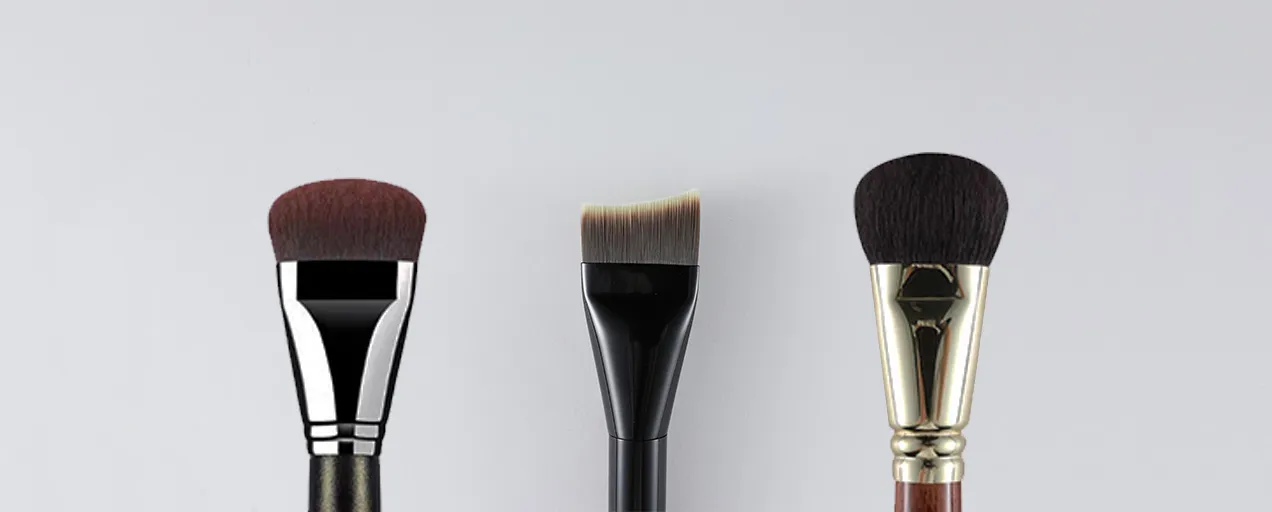
What do you think makes the best foundation brush? Is it the softest bristles, the most expensive brand, or the one that goes viral on social media? In reality, there is no single universal “best” brush, because every head shape and fiber type is designed to work for a specific skin type and a specific foundation formula.
A flat brush that lays down a thin veil of liquid will never behave like a dense polishing brush for cream foundation, and a brush that looks perfect in a product photo can easily waste half of your liquid base inside the core. The real question is not “Which brush is the best?” but “Which foundation brush is best for your skin and your foundation?”.
If you want to understand handle construction, ferrules and long‑term durability in detail, read our How to Choose the Best Quality Makeup Brush guide, then come back here to match your ideal foundation brush to your favorite formulas.
Step 1 – Understand Your Skin Before You Buy Any Brush
Before you look at shapes and fibers, start with your skin. How it behaves will define how soft the bristles should be and how much pressure you can use.
Ask yourself:
- Is your skin dry, normal, combination, or oily?
- Does your skin flush, sting, or itch easily when you rub it?
- Do you struggle more with flakes and dehydration, or with excess shine and clogged pores?
Why this matters:
- Dry or sensitive skin needs softer, more flexible synthetic bristles that glide without scratching or lifting dry patches.
- Oily or acne‑prone skin benefits from denser synthetic bristles that can handle frequent deep cleaning without losing shape.
Step 2 – Choose the Foundation Formula First
Only after you understand your skin should you decide what kind of foundation you actually enjoy wearing. Your version of the best foundation brush will always be matched to this formula.
Main foundation families:
- Liquid foundation – from watery tints to thicker, serum‑like bases; easy to spread but prone to streaks and waste with the wrong brush.
- Cream and stick foundation – richer and more concentrated; provide higher coverage and need more blending power.
- Powder foundation – quick, breathable and ideal for touch‑ups; can emphasize dryness if the brush is too rough or stiff.
Someone who loves sheer, dewy liquid with natural coverage will never use the same foundation brush as someone wearing matte cream foundation for long days. Decide on the formula first; then start looking at brush shapes.
Step 3 – Liquid Foundation: Flat, Straight Bristles to Control Waste
For true liquid foundations, the most efficient best foundation brush is a flat, straight‑cut synthetic brush, not a very dense round buffer.
Why flat brushes are ideal for liquid:
- They spread a thin, even layer of foundation across the skin surface instead of letting product sink deep into the brush head.
- Straight synthetic fibers absorb less liquid, so less formula is wasted inside the core of the brush.
- You can control exactly how much foundation you pick up, place it precisely, and then gently sweep or pat it out.
How to use a flat liquid foundation brush
- Pump a small amount of foundation onto the back of your hand.
- Load only the surface of the brush, not the entire head.
- Paint short strokes from the center of the face outward.
- Finish with light patting motions to remove streaks and keep coverage even.
Step 4 – Cream and Stick Foundations: Dense Polishing Brushes
Cream and stick foundations are thicker and more pigmented, so they pair best with dense polishing brushes that have enough strength to move the product and buff it into the skin.
What dense polishing brushes do well:
- They grip creamy textures and push them evenly across the skin with small circular motions.
- Pressing and buffing help “melt” the foundation into the skin, then polish the surface for a smooth, unified finish.
- They are perfect for building medium‑to‑full coverage in layers without patchiness, especially on normal and combination skin.
Why they are not ideal for thin liquids:
- Ultra‑dense round brushes tend to drink up fluid formulas, trapping a lot of liquid foundation inside the core where you cannot use it.
- You end up applying less to the face and wasting more on the brush, even though the finish may look polished.
How to use a dense polishing brush with cream foundation
- Swirl the brush lightly over the cream compact or swipe it across the top of a stick.
- Press the product onto the skin in a stippling motion where you want coverage.
- Buff in tight circular motions to smooth the surface and blend edges.
Step 5 – Powder Foundation: Fluffy, Airy Brushes for an Even Veil
Powder and mineral foundations need fluffy, airy brushes that move pigment gently without grinding it into every line or dry patch.
What to look for:
- A rounded, dome‑shaped or kabuki head with flexible bristles.
- Enough fluff to diffuse powder, but not so loose that the brush becomes hard to control.
- Bristles that feel soft when you swirl them across the skin, especially on drier areas like cheeks and around the mouth.
Application tips:
- Load the brush by swirling in the compact, then tap off the excess.
- Use light circular motions over the face and gentle pressing where extra coverage is needed.
- If powder looks cakey, reduce the amount of product and pressure rather than switching foundation immediately.
Step 6 – Technique: Buffing, Stippling or Sweeping
Even the best foundation brush will underperform if the technique does not match your skin and formula. Think in terms of three simple motions:
- Buffing
- Stippling (pressing / tapping)
- Sweeping
Your skin should decide the pressure: buff less when it feels fragile, stipple more over problem areas, and sweep when you only want a veil of foundation.
Step 7 – Put It All Together: Your Personal Best Foundation Brush
To make everything practical, use this simple path to find your own best foundation brush:
- Dry or sensitive skin + liquid foundation →
- Soft, flat synthetic foundation brush.
- Light sweeping and patting, minimal buffing.
- Combination or oily skin + liquid foundation →
- Flat synthetic brush or slightly denser hybrid head.
- Controlled strokes from the center of the face outward.
- Any skin type + cream or stick foundation →
- Dense polishing/buffing brush with synthetic fibers.
- Press, then buff in small circles for a polished finish.
- Normal to oily skin + powder foundation →
When your skin type, foundation formula, brush shape and technique line up, your foundation brush stops fighting your base and starts working with it. At that point, the best foundation brush is not a single trending product, but the tool that is correctly matched to the way you wear foundation—backed by the quality standards you already defined in your main brush pillar page.

